
A shooting rest exists to answer one question: where does this rifle shoot, as opposed to where do I shoot it?
Until the rifle is held still by something other than your hands, you cannot tell whether a group opened up because of the ammunition, the optic, or your trigger press. A rest removes you from the equation long enough to find out.
Three approaches, three different jobs
Front and rear bags are what benchrest and precision shooters use. The rifle sits in a front bag and its toe rides a rear bag, and nothing restrains it — it recoils naturally, straight back. You adjust elevation by squeezing the rear bag. Cheap, simple, and the closest thing to a neutral platform.
Sleds clamp the rifle into a weighted carriage. Adding twenty or thirty pounds of dead weight absorbs most of the felt recoil, which lets you sight in a heavy-kicking rifle without developing a flinch halfway through the process.
Bipods attach to the rifle itself and fold away. They are a field tool for prone and improvised positions, not really a bench tool — a bipod plus a rear bag is a perfectly good sighting setup, but it is less stable than a proper front rest.
The lead sled question
Sleds are genuinely useful and genuinely controversial, and most articles pick a side without explaining the argument. Here it is.
The case for. Recoil is what makes people flinch, and flinch is what ruins sighting-in. A weighted sled removes almost all of it, so you can shoot a magnum rifle carefully rather than bracing against it. And because the rifle-plus-sled assembly is far heavier, its free recoil velocity is much lower, which means the scope actually experiences less acceleration along the bore axis, not more.
The case against. That energy does not vanish. When a rifle is clamped into something immovable, stress that would have been absorbed by moving backward into your shoulder gets transferred into the stock instead. There are credible reports of cracked tangs on wood-stocked rifles used heavily in weighted sleds, and rifles with loose factory bedding are the most exposed, because the action can shift slightly within a stock that is being held rigid.
The practical answer. Use a sled for what it is good at — getting a hard-kicking rifle on paper and zeroed — and not as your everyday bench setup. Do not add more weight than you need. Do not cinch the rifle down as though you are trying to immobilize it. And if you shoot a wood-stocked magnum, be especially conservative, or use bags instead.
For a .223 or a .22, none of this is worth worrying about. The debate is about heavy recoil.
What a rest will not do
It will not make you a better shooter. It tells you what the rifle and ammunition are capable of, which is a diagnostic rather than a skill.
The useful habit is to alternate: shoot a group off the rest to establish what the rifle does, then shoot the same drill from a field position and compare. The gap between the two is your technique, and that gap is the thing worth practicing.
The picks
Lead Sled MAX — for rifles that hurt

The tool for zeroing a magnum, a heavy slug gun, or anything else you would otherwise be tempted to rush through. Load the tray with weight, settle the rifle in, and the recoil that would have you flinching by round five largely disappears.
Follow the guidance above: it is a sighting-in tool rather than a bench you live on. Use enough weight to tame the recoil and no more, and go easy on wood-stocked rifles.
Not portable in any meaningful sense — this lives in the truck and comes out at the bench.
Buffalo Creek Front and Rear Rest — the sensible default

A front and rear bag set, which is the configuration precision shooters actually use. The rifle recoils naturally, nothing is clamped, and there is no stress argument to have.
Elevation comes from squeezing the rear bag, which sounds crude and is remarkably precise once you have done it a few times. It also packs into a range bag and costs a fraction of a sled.
If you shoot ordinary calibers and want one setup for load development and zeroing, buy bags rather than a sled.
Buffalo Creek Sandbag — the simple one
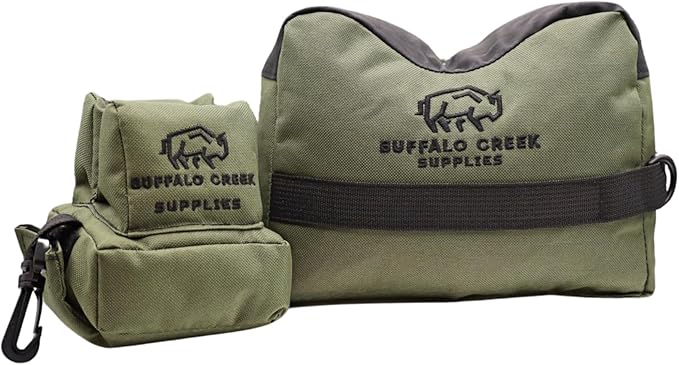
A single all-weather rest bag. Less adjustable than a two-piece set, and entirely adequate for confirming a zero or shooting groups at 100 yards with a rifle that does not punish you.
The honest recommendation for most people buying their first rest: start here, and move to a front-and-rear set if you find yourself chasing quarter-inch groups.
CVLIFE Bipod — for shooting off the rifle

A folding 6-9 inch bipod that attaches to the rifle and travels with it. Useful in prone, off a tailgate, or anywhere a bench is not available.
Understand the tradeoff: a bipod loads against the rifle itself, so it interacts with recoil in a way a separate rest does not, and the bipod-plus-rear-bag position is less stable than a proper front rest. Good for field shooting. Not the tool for deciding whether a new load groups.
Common questions
Do I need a rest to sight in?
Something to steady the rifle, yes. It does not have to be a purpose-built product — a rolled-up jacket over a rested pack is better than nothing. But sighting in off your hands wastes ammunition proving your own inconsistency.
Will a lead sled damage my rifle?
Unlikely with ordinary calibers used sensibly. The risk is concentrated in heavy-recoiling rifles, wood stocks, and over-weighted sleds cinched down hard. Use it to zero rather than for long sessions and the concern largely goes away.
Bags or a sled for a .223?
Bags. There is not enough recoil to justify a sled, and bags give a more natural platform for group shooting.
Can I use a bipod on a bench?
You can, and plenty of people do. It is less stable than a front rest and the legs can skate on a smooth bench top, so add a rear bag and expect slightly larger groups than the rifle is truly capable of.
Before you go
You will want to see where those shots landed — that is covered in our guide to spotting scopes. The rest of the range kit is in ear protection, range bags and cleaning kits, all indexed at range gear.